
Documill for Manufacturers: Real Use Cases, Real Benefits
At Documill, listening to customers’ long-term wishes is the basis for feature development. See how we fulfil manufacturers’ future strategies.
In 2026, manufacturing companies face unprecedented operational and market pressures: accelerating competition, surging energy prices, global trade disruptions, and logistical strain.
These challenges have pushed manufacturers to rethink how they manage their customer engagement, frontline productivity, and core digital systems.
As part of this rethink, many leading manufacturers are building and rolling out some of the world’s most complex Salesforce implementations. Inside these environments, Salesforce‑embedded document and workflow automation stands out as a key enabling capability.
And this is where Documill plays a vital role, enabling manufacturers to:
- adapt quickly to new customer demands
- streamline critical document-heavy processes
- scale efficiently under market pressure.
Key Manufacturing Trends Shaping 2026
Across customer projects and industry discussions, we see several dominant themes continue to shape the manufacturing landscape — as an answer to the challenges they are facing:
- Shift to B2C and Personalization: Manufacturers increasingly bypass intermediaries to directly sell to and support consumers.
- Product customization and localization: Shift to more personalized, market‑specific products.
- Data-Driven and AI-Powered Sales: Sales teams depend on CRM data, its quality, and AI for targeted selling.
- Efficiency and Investment in Growth: Manufacturers invest in efficiency tech to boost revenue and increase competitiveness.
- Workforce Evolution: Jobs shift toward technology-driven, higher‑skill positions, requiring more training and onboarding efforts.
- Value-Added Services and Ecosystems: Expansion into services like 3D printing, additional software, and advanced maintenance.
Let’s break down now, how Documill adds value for manufacturers adapting to these strategies.
Where Documill Delivers Value
Documill’s document automation capabilities are tightly integrated with Salesforce clouds, enabling manufacturers to address the following industry trends with precision, scalability, and speed.
Supporting the B2C Shift
To support manufacturers’ centralized Salesforce organizations, Documill ensures critical customer interactions are documented and delivered consistently — whether through portals, mobile, email, or integrated platforms.
Its multilingual and multi‑locale capabilities enable seamless global operations as brands expand direct‑to‑consumer strategies.
Powering Personalization and Data‑Driven Sales
Documill enforces high data quality through Salesforce‑embedded workflows and supports complex product portfolios with advanced template configuration logic.
This ensures that personalized offerings, quotes, and customer communications are always accurate and aligned with the underlying data structures powering AI‑driven sales. Without costly errors.
Enabling Efficiency and Workforce Evolution
By automating time‑consuming document tasks, Documill frees frontline workers from repetitive activities.
The efficiency gains that follow create room for employees to focus on higher‑value, skill‑based responsibilities.
Managing Complexity in Value‑Added Services
As manufacturers broaden their service offerings, Documill provides a unified document automation layer across Sales Cloud, CPQ, Service Cloud, and other Salesforce systems. Its deep integrations support personalized service configurations and deliver a 360° view of customer touchpoints.
Real Use Cases Across the Whole Manufacturing Lifecycle
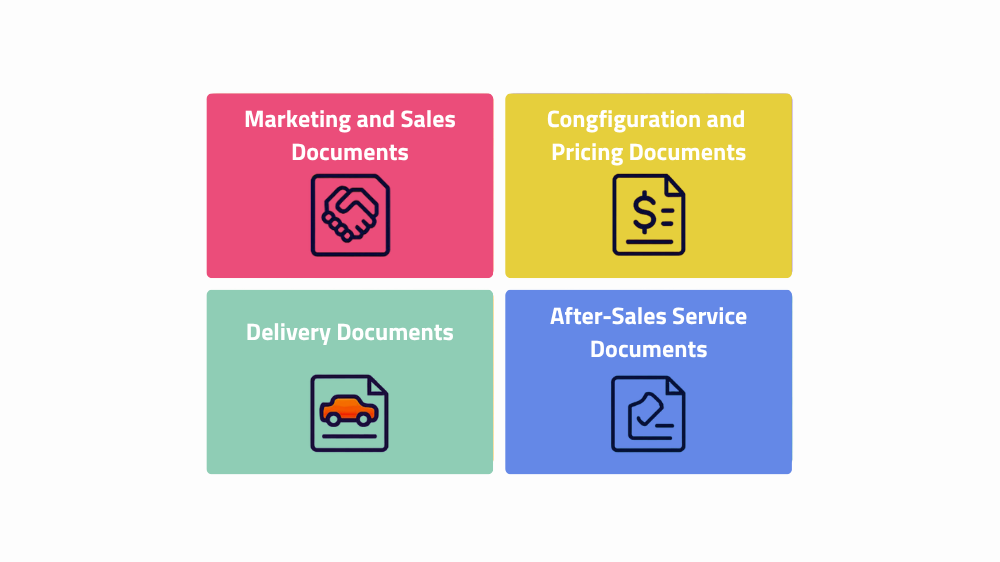
Documill’s solutions span the full customer journey — from early marketing engagement to after‑sales service. Examples include:
- Marketing & Sales.
Solutions include large‑scale product catalogs, integrated data‑collection forms, automated sales quotes, proposals, and automated or even negotiated contracts with clause libraries and e‑signatures. - Deliveries.
Manufacturers use Documill for generating invoices, order confirmations, picking lists, mobile sales documents, shipping materials, packing lists, and delivery notes for test equipment and demos. - Incidents & Field Services.
Documill automates the creation of incident reports for safety or quality issues, structured customer complaint responses, and field service reports and certificates.
Built for Manufacturing Needs
Documill’s growing portfolio is grounded in what we see manufacturers valuing most. To conclude, let’s recap the key benefits:
- Premium user experience: No need for user training. Just seamless connection with CPQ and Manufacturing, Sales, Service, and Experience Clouds to provide a unified, familiar Salesforce user experience.
- Adaptivity to manufacturers’ specific needs: As the product portfolios grow more personalized and varied, Documill can handle the complexity.
- Multi-channel, multi-language delivery: Use a centralized system across channels, markets, languages and locales.
- E-signing capabilities included: No need for third-party tools.
- ISO27001 and industry-compliant: Built to meet the highest standards of data security and regulatory compliance.
- Five-star solution and customer service: 4.96/5 average in Salesforce AppExchange.
To explore how Documill can enhance your Salesforce document processes, see our document automation guide for manufacturers.