Extending Automotive Manufacturers’ Salesforce Implementations with Document Automation
Global automotive brands run some of the world’s most complex Salesforce environments. What are their document automation use cases?
The automotive industry is going through major changes. Electric and hybrid vehicles are gaining traction, semi‑autonomous driving is becoming mainstream, and ownership models like leasing, renting, and subscriptions are reshaping customer expectations. Connectivity now defines the service experience, and the shift toward the Agency (or Fleet Agency) Model is accelerating.
In the middle of all this sits Salesforce — arguably one of the most important systems automotive manufacturers rely on today. Global brands run some of the world’s most complex Salesforce environments, connecting sales, fleet operations, dealers and agents, and aftersales teams. The system holds the customer, product, and pricing data that keeps everything moving.
Document automation strengthens this foundation by bringing automated, reliable document generation directly into Salesforce. Instead of relying on external tools, manual work, or inconsistent templates, manufacturers can generate accurate, compliant, and brand‑aligned documents straight from Salesforce data. It helps standardize documentation, reduce operational risk, and still gives local markets the flexibility they need.
This article walks through the most important Salesforce use cases where document automation adds value — based on what automotive organizations are doing today and what works in real-world implementations.
The Automotive Salesforce Landscape
Most manufacturers use Salesforce across several domains for lead tracking and sales processes:
- Automotive Cloud for vehicle and fleet operations
- CPQ for configuration and pricing
- partner portals for dealers and agents
- Service Cloud for after-sales.
In these environments, documents are not just formalities. They influence revenue, determine compliance outcomes, and shape the overall brand experience. Getting them wrong — or producing them inconsistently — creates risk at scale.
Key Salesforce Use Cases for Automotive Manufacturers
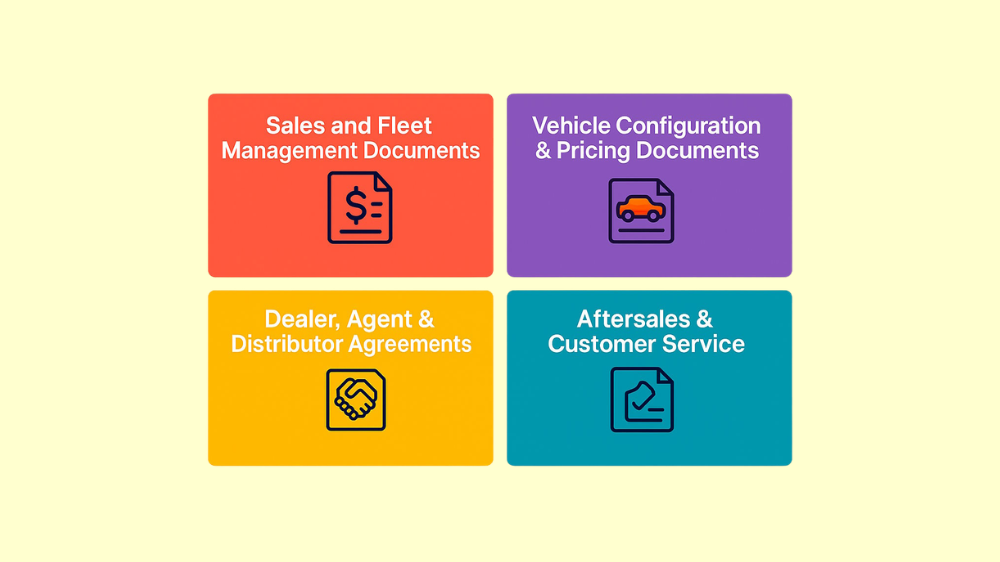
1. Sales and Fleet Management Documents
Sales in the automotive world are anything but simple. Fleet and B2B deals involve complex pricing structures, volume tiers, local legal nuances, and brand‑specific rules. When documents are created manually, errors creep in — wrong prices, mismatched volumes, outdated terms. That slows deals and introduces revenue leakage.
With document automation, teams can generate sales agreements, fleet contracts, and commitment summaries directly inside Salesforce Automotive Cloud.
- pricing always reflects Salesforce CPQ data
- legal clauses stay governed centrally
- local variations appear automatically where needed.
2. Vehicle Configuration & Pricing Documents
Vehicle configuration is one of the most complex parts of the sale. Customers expect perfect accuracy in their quotes, option lists, and pricing — across brands, models, and markets.
Document automation transforms CPQ data into clean, customer‑ready documents without any copy‑paste. Configuration summaries, pricing annexes, and localized versions come from a single template that adapts to market, language, and brand rules.
This leads to
- more accurate documents
- a smoother sales experience
- better protection of the margin.
3. Dealer, Agent & Distributor Agreements
Manufacturers rely on large dealer and distributor networks. These partnerships require consistent documentation
- contracts
- amendments
- bonus programs
- compliance acknowledgements.
Yet every market has its own legal and commercial specifics.
Document automation supports automated agreement creation using Salesforce partner data. Templates are controlled centrally to maintain brand standards, but still allow local versions and languages. This keeps partner networks aligned without slowing down individual markets.
4. Aftersales & Customer Service
After-sales operations generate an enormous amount of customer‑facing documentation:
- service agreements
- warranty information
- maintenance reports
- various communications via email, for instance.
These documents must be accurate, fast to produce, and fully aligned with brand guidelines.
Document automation enables service teams to generate documents directly from Salesforce service records and cases. The content stays consistent across brands and markets, and manual effort is greatly reduced.
Compliance & Information Security
Compliance requirements required by the automotive manufacturers in Europe — such as TISAX, data protection regulations, and audit frameworks — demand rigorous control over documents. Knowing exactly which version of a document was used, where the content came from, and who generated it is essential.
Document automation provides version control and audit trails directly inside Salesforce. Users can only generate documents using approved templates, keeping compliance built into the process instead of relying on manual oversight.
Global Scale with Local Flexibility
Automotive groups usually operate multiple brands across many countries, each with its own languages, regulations, and product portfolios. Balancing global consistency with local needs is a constant challenge.
Document automation supports a global document framework in Salesforce where rules define which variations apply to which markets. Templates can be reused across brands, but still adapt to local requirements automatically. This lets manufacturers scale without sacrificing local relevance.
Why Embedded Document Automation Matters
At the automotive scale, data duplication increases risk, and external tools add complexity. Governance needs to happen inside the system where the data lives.
The biggest advantage of document automation inside Salesforce is that everything remains within a single platform:
- users stay in the familiar interface
- data stays in one place
- automation can be tied to Salesforce-defined workflows
- Salesforce becomes the true single source of truth.
Conclusion
Salesforce is the operational backbone for many automotive manufacturers, supporting everything from sales to partner management to aftersales. Document automation enhances that backbone by ensuring that every document — whether it’s a quote, contract, service report, or supplier agreement — is
- accurate
- compliant
- available across different brands and markets.
Together, Salesforce and document automation help manufacturers move faster, reduce risk, and maintain global consistency without losing local flexibility. They turn Salesforce data into trusted, governed documents — built for automotive scale.
Do you want to learn more about the exact use cases for automotive manufacturers? In this guide, you can learn about the implementations we have already made.